COGNITIVE HEALTHSPAN
Longevity's Blind Spot

Paola Telfer

In the longevity rooms I have been in this past year, we are measuring almost everything. VO2 max. DEXA scans. Blood markers. Full-body MRI. Sleep, steps, heart rate variability, glucose. The body is covered.
But the brain is not. The organ that decides whether the years we are adding are worth living is the one we barely measure.
This is longevity's blind spot. Closing it is the work of cognitive healthspan. And it is starting to happen.
The organ that decides whether the years we are adding are worth living is the one we barely measure.
What the brain actually predicts
A 2025 study from the Wyss-Coray Lab at Stanford Medicine, published in Nature Medicine, drew on 44,500 participants from the UK Biobank and 17 years of follow-up. The question was simple: across 11 organ systems, which one best predicts how long a person will live?
The answer was the brain.
People with the most youthful brains had a 40 percent lower risk of death over the following 15 years. People with the most aged brains had a 182 percent higher risk. And someone with one of the most aged brains was about 13.5 times more likely to receive an Alzheimer's diagnosis than someone the same age with one of the most youthful brains, regardless of genetics. Read that again.
Not 13 percent more likely. Thirteen and a half times.
If you are going to invest in measuring one organ, the data says it should be this one.
Why it has been the blind spot
The body declines visibly. The brain declines silently.
As the body ages, you see it. So does everyone around you. You feel the difference in your VO2 max. Your DEXA scan tells you about your bones.
As the brain shows signs of aging, you explain it. You tell yourself it is stress. You tell yourself it is normal. You tell yourself everyone your age forgets a word sometimes, loses the thread in a meeting, feels the fog by mid-afternoon. The signal arrives, and you talk yourself out of it.
By the time cognitive change is visible to other people, the trajectory is often hard to reverse. The opportunity is to see what is happening before it surfaces. Which raises the question: how do you actually measure a brain?
Why existing measurements fall short
There are essentially four approaches.
Structure. MRI looks at the physical architecture of the brain. The problem: by the time you can see structural change, function has already been lost. Structure is the aftermath, not the signal.
Proxies. Blood markers correlate with what is happening in the brain. They are useful and increasingly sophisticated, but they are still indirect. You are inferring brain activity from molecules in the periphery.
Electrical signals at rest. EEG and QEEG capture brain activity, which gets us closer to direct measurement. But resting-state recordings are volatile. They fluctuate with mood, sleep, caffeine, time of day. They capture the brain's idle hum, not what it can actually do.
Cognitive output. Reaction time, memory recall, scores on standardized tests. This measures what comes out of the brain, but it does not tell you why. Two people can have the same reaction time and very different underlying efficiency. One brain is running clean. The other is running hot, working twice as hard to produce the same result. Cognitive testing does not let you see which is which.
That is the gap. Each approach captures a fragment: the aftermath, the inference, the idle hum, or the outcome without the mechanism. None of them show you how the brain is functioning.
Under the hood
Here is what we built, and it starts from those same four approaches. Two of them are dead ends for measuring function: structure shows the aftermath, and blood markers stay indirect. The other two, the electrical signal and the cognitive output, are the right raw materials, as long as you fix what made each fall short. So we took both, corrected them, and added the one thing none of the four captures on its own: brain function under load.
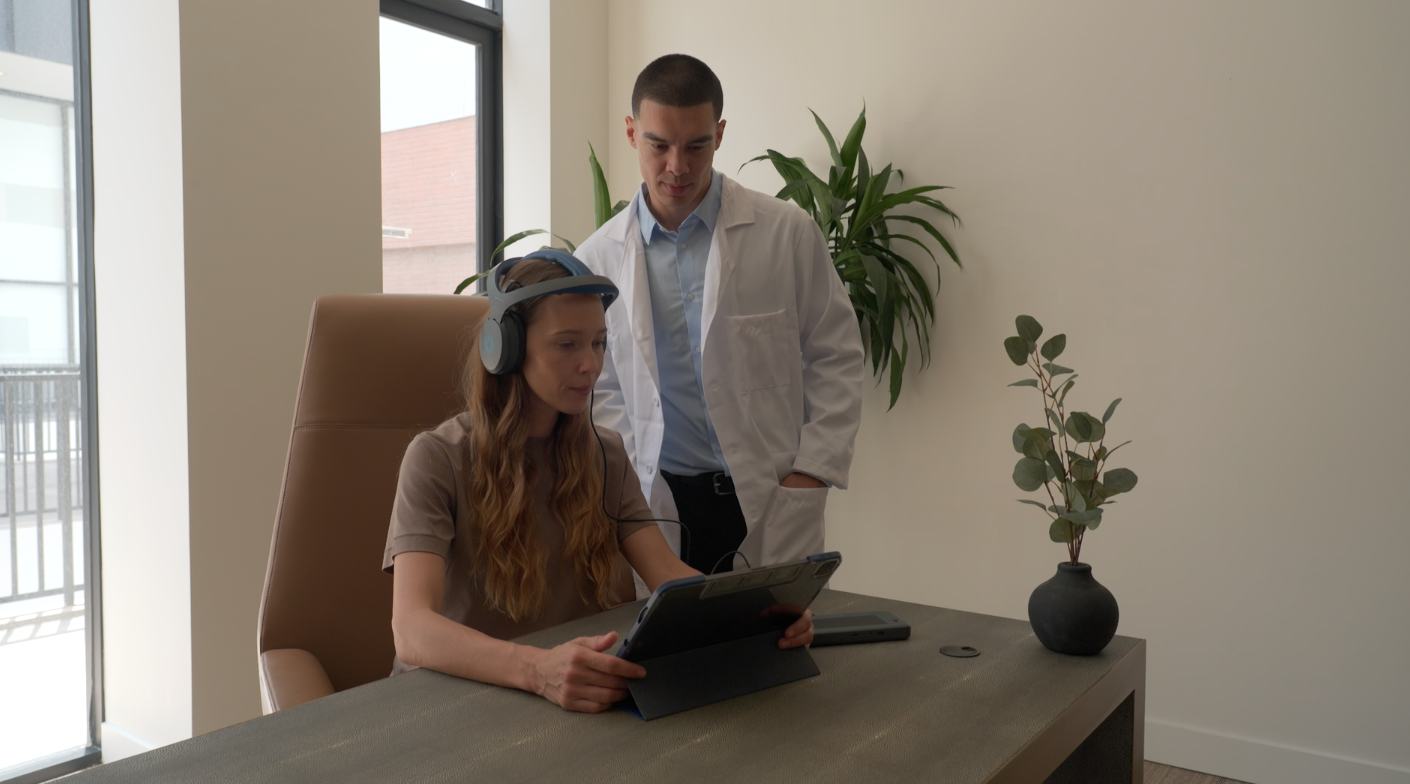
A single 15-minute assessment captures three streams at once, all while the brain is working through a cognitive task rather than sitting at rest.
The electrical signal, but not at rest. We record EEG during the task instead of in the idle state, which strips out the volatility that comes with mood, sleep, and caffeine.
Brain function, the layer the others miss. During that same task we capture event-related potentials, or ERPs: the brain's response to specific stimuli, at one-millisecond precision. ERPs are to resting EEG what an exercise stress test is to a resting heart rate, the signal under load that the idle recording cannot give you.
The cognitive output, in the same moment. The accuracy and timing of the responses, recorded alongside the EEG and ERPs rather than as a separate test, so the output is tied to the brain activity that produced it.
These three are not alternatives to each other. They are complementary signals from one session, each capturing a different dimension of the same brain at work. Together they become the inputs to a machine learning model trained on 643 biomarkers.
A clock, not a snapshot
A measurement is not the same as a model. Most brain measurements available today are snapshots. They tell you where you are right now. They do not tell you where you are headed.
For that, you need an aging clock.
Biological aging clocks have transformed how the longevity field thinks about other organs. We have blood-based clocks. We have methylation clocks. We have functional clocks for cardiovascular and metabolic systems. For the brain, the clocks have largely been built on structure (MRI) or blood markers (proxies). Sens.ai has built the first one based on function.
BrainYears™ is the first functional brain age clock. The result: a single number that tells you the functional age of someone's brain, with an R correlation of 0.92 against chronological age and a mean absolute error of 4.4 years.
Those numbers match the accuracy of MRI-derived brain age clocks, the structural gold standard. And critically, within-person change between assessments is approximately 0.07 years. That means when your client's number moves, it is real. The trajectory signal is rock solid.
We developed BrainYears™ in collaboration with the Buck Institute for Research on Aging. The validation study is pre-published on BioRxiv for anyone to review.
"It turns out to be one of the best clocks that we've ever generated, in terms of the prediction and the flexibility."
Eric Verdin, MD, President and CEO, Buck Institute for Research on Aging
What the brain can do
Knowing your brain's functional age is the starting point. The deeper question is whether it can change.
The Sens.ai system is designed to answer that. A measurement without an intervention is just a number. The same validated clock, applied before and after, tells you whether brain function actually moved. Assess, intervene, reassess: that loop is what turns a number into a trajectory you can change, rather than a one-time data point.
On the intervention side of the same Buck study, participants who completed Sens.ai's Sharp Mind protocol, a two-month at-home neurofeedback program, showed a mean improvement of 5.18 BrainYears. Processing speed improved 10.2 percent and errors decreased 40.6 percent on a standardized attention test. The group without the intervention saw little change by comparison. And it was felt, not only measured: 73 percent of participants reported improved memory and mental clarity.
That is not self-reported wellness alone. That is brain function changing, measured the same way before and after.
We are still early, and there will be cases where trajectory is harder to move. We are committed to understanding why. But the evidence so far is clear: for many people, the brain has more capacity to change than longevity has assumed. The infrastructure to explore that capacity, at home and in clinic, finally exists.
For many people, the brain has more capacity to change than longevity has assumed.

What this means for the longevity field
The longevity field has spent the last decade building the dashboard for the body. It is becoming more complete every year. The brain has been the missing pane.
That pane is now buildable. A validated functional clock, and a closed loop to move it, assess, intervene, reassess. The pieces fit together.
For longevity clinics: brain function is what your clients are most afraid of losing. Adding a functional brain assessment to your dashboard meets that fear with something measurable, actionable, and trajectory-aware.
For longevity-focused investors: cognitive measurement is in the position wearables were in fifteen years ago. The category will define a layer of the next decade.
For someone thinking about their own healthspan: the brain is the organ whose decline most directly predicts how long you will live. If you measure one thing, measure this.
And the timing is not incidental. We are the first generation asking our brains to share the work of thinking with machines. Knowing your brain's baseline, and protecting it, has never mattered more.
BrainYears™ is here. We launched in June 2026 and are already onboarding our first clinics. The brain has been longevity's blind spot. Cognitive healthspan is not a blind spot anymore.
DISCLAIMER
This content is for informational and educational purposes only. It is not intended to provide medical advice or to take the place of such advice or treatment from a personal physician. All readers/viewers of this content are advised to consult their doctors or qualified health professionals regarding specific health questions. Neither the author or Sens.ai, the publisher of this content takes responsibility for possible health consequences of any person or persons reading or following the information in this educational content. All viewers of this content, especially those taking prescription or over-the-counter medications, should consult their physicians before beginning any nutrition, supplement or lifestyle program.