The Sens.ai Platform
The only closed-loop system that combines brain stimulation, brain training and objective brain function assessments.
The Closed Loop
BrainYears™ powered by Sens.ai establishes where a client's brain function stands. The client then follows an at-home intervention, called a Mission: a structured 5- to 12-week protocol of Train and Boost sessions on a Sens.ai headset, recommended from the client's assessment and goals.
Two to three months later, after the at-home Mission, the practice reassesses the client, and the report shows how far their brain function has moved from that first result. The reassessment gives the practice an objective measure of what changed over the Mission, and gives the client a result they can see in their own report rather than a sense of how they feel.
Access to Missions at home comes with the three-month Personal Membership included in BrainYears™ Unlimited.
Inside Each Session
Each mark on the ring is a session, and each session closes a loop of its own while it runs.
Train
During a Training session the headset reads the brain's electrical activity and answers with sound and image in about 200 milliseconds, well under the speed of analytical thought, so the brain adjusts below the level of deliberate decision. The feedback adapts as the client improves. Each session delivers either EEG neurofeedback or Calm Heart, which trains heart rate variability through breathing at the client's personal resonance rate.
Boost
A Boost session pulses near-infrared light through the scalp, paired with binaural beats, to move the brain toward a target state such as calm, focus or cognitive clarity. At home, the EEG sensors read the client's brainwaves live and tune the pulsing frequency within the target band to the client's own rhythm, where most photobiomodulation products deliver one fixed frequency to everyone. In the practice, Boost sessions are customized from three short questions and run without the sensors.
Between them, the Training and Boost programs span the brain states a practice works with, from Snooze and Deep Calm at one end to Focus, Clarity and Drive at the other. The science behind each mode is set out on our science page.
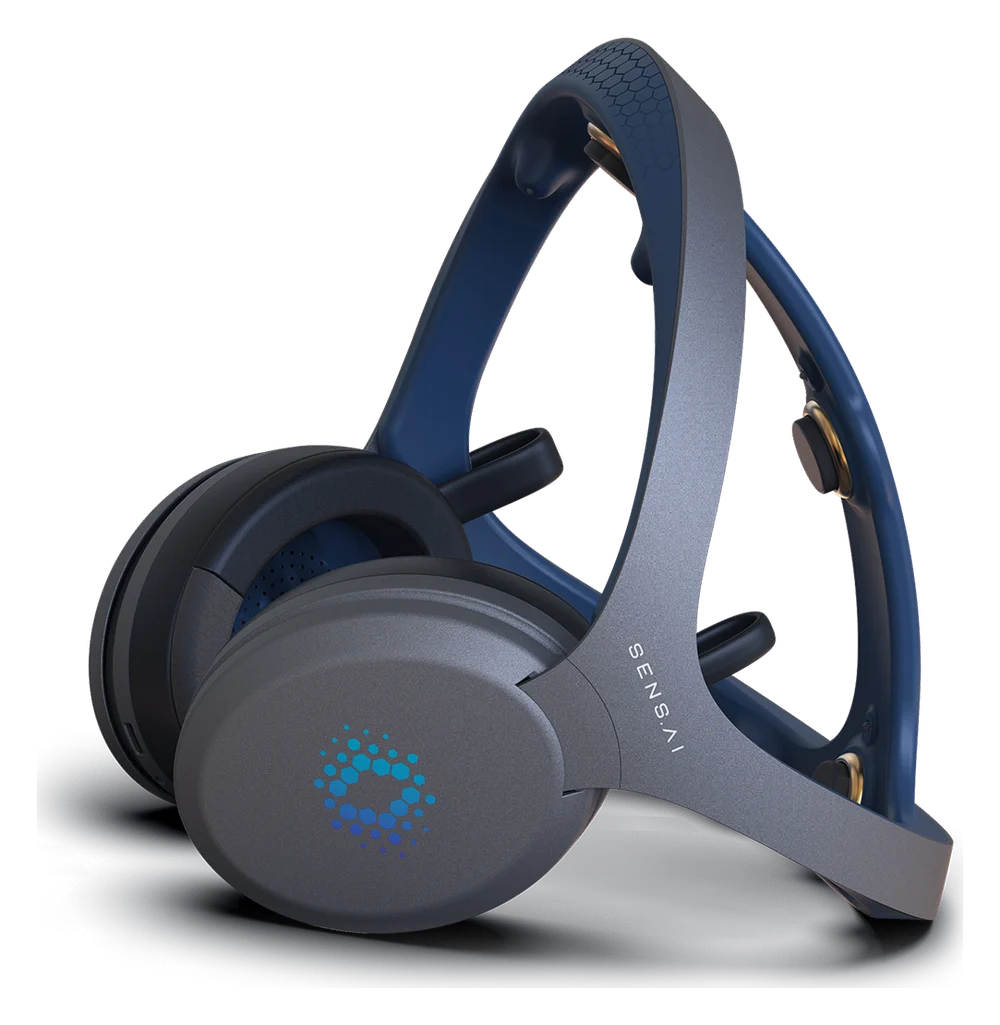
Select a number to see what each part of the headset does.
Seven near-infrared LEDs at 810 nm deliver the transcranial photobiomodulation (tPBM) in every Boost session.
Three electrodes along the midline of the patented headset read lab-grade EEG from 1 Hz to 120 Hz, for both neurofeedback and the assessment.
Headphone audio carries the neurofeedback cues, the binaural beats and the guided audio, and some programs add visual feedback in the app.
A sensor in the left earcup reads heart rate, heart rate variability (HRV) and heart rate coherence for Calm Heart. It is not part of the BrainYears™ assessment.
Measured Under Cognitive Load
When someone approaches with an arm half-raised, the brain has a fraction of a second to work out whether a handshake or a hug is coming: it filters what it sees, classifies it, decides on a response and acts. BrainYears™ powered by Sens.ai traces that sequence during an event-related potential (ERP) task, recording the brain's responses at 1 ms precision while it works.
Filter
Early sensory response
143 ms
Classify
Sorting the stimulus
255 ms
Decide
Choosing the response
389 ms
Act
Pressing the button
395 ms
Illustrative values for a single response.
How the AI Model Estimates Functional Brain Age
Throughout the task, the headset measures the brain's electrical activity and its response to every stimulus, and the controller captures how quickly and accurately the client answers. BrainYears™ powered by Sens.ai processes those measurements into over 2,000 biomarkers of brain function and performance, and its AI model uses 643 of them to estimate a functional brain age: the age at which the client's brain is working, not their age on a calendar.
The model is pre-published on bioRxiv, developed in collaboration with the Buck Institute for Research on Aging, and now undergoing peer review.
The BrainYears™ Portal
Every practice running BrainYears™ powered by Sens.ai manages it through the BrainYears™ Portal, which holds the practice's clients, its team and every report it has issued, so the work of assessing clients over months and years stays in one place.
Client Management
Each client has a record, created from their name, date of birth and email, and every assessment the practice schedules or runs is attached to it. Because each report carries the client's full assessment history, the client record is where a practice follows a functional brain age from the first assessment through every reassessment.
Your Team
Add each location and the team logins that work in it, and give each person a role that matches what they do, from running assessments to managing clients and downloading reports. Temporary logins limited to running assessments expire on their own, so short-term access never opens the rest of the Portal.
Reports
Every report carries the practice's logo on its cover and is emailed to the client directly from the Portal. The practice also sets the instructions clients see when their assessment is complete, messages clients from the same place, and can see its assessment usage at any time.
Onboarding
The Portal also holds the practice's onboarding: setup guides with tutorial videos, the facilitator guide for running an assessment, a pre-appointment note to adapt for clients, and the headset cleaning procedure.
Running BrainYears™ in Your Practice
We provide the headset, with its controller, and access to the BrainYears™ Portal, while your practice runs the assessment app on its own iPad or tablet. Your staff fit the headset and start the assessment, the client completes it with the controller, and no EEG or neurological background is needed to run it.
BrainYears™ powered by Sens.ai is a discrete, 20-minute assessment with the report back in minutes. It is not a wearable or a form of continuous monitoring, because nothing is worn between visits.
Under the Hood
The full specifications of the patented Sens.ai headset and BrainYears™ powered by Sens.ai.
EEG
Three electrodes along the midline at Fz, Cz and Pz, placed over the hubs of the brain's rich club network.
Reads from delta to the 3rd harmonic of gamma, 1 Hz to 120 Hz.
Up to 1,000 samples per second.
Lab-grade EEG in a consumer form factor.
ERP Recording
Event-related potentials recorded at 1 ms precision.
An event-related potential (ERP) task with visual stimuli only.
A 20-minute assessment, 8 minutes of which is the measured task.
Ages 24 and up.
BrainYears™ AI Model
Over 2,000 biomarkers of brain function and performance, 643 of them used to produce a functional brain age.
r = 0.92 correlation with chronological age, and a mean absolute error of 4.4 years.
BrainYears™ Report
One functional brain age, the AI model's output from the full biomarker set.
Percentiles in four cognitive domains, against age-matched norms: Information Processing, Attention, Self-Regulation and Performance Output.
Each repeat assessment plotted against the client's full history.
Personalized recommendations covering exercise, sleep, neuromodulation, stress and nutrition.
Neurofeedback
A feedback loop of about 200 ms.
Over 1.4 million data points processed in real time per Training session.
Adaptive thresholding personalizes the feedback over time.
HRV Biofeedback
Pulse oximeter in the left earcup, 800 samples per second.
Tracks heart rate, HRV and heart rate coherence.
Not captured during the BrainYears™ assessment.
Transcranial Photobiomodulation (tPBM)
7 specialized LEDs at 810 nm.
312 mW/cm² per LED.
Pulsed across 0 to 1,024 Hz, matched to the target brain state.
Paired with binaural beats.
Headset and Controller
The patented headset weighs 15.2 oz (0.43 kg), with headphone audio.
Every headset includes its own handheld controller, which captures each response to the visual stimuli.
Lithium batteries and USB-C charging; a full charge runs multiple sessions.


Disclaimer
BrainYears™ is a wellness tool that provides insight into your cognitive performance and functional brain age. It is not a medical evaluation, diagnosis, or treatment recommendation, and does not indicate the presence or absence of any disease or medical condition.