COGNITIVE HEALTHSPAN
The Leadership Frequency: How to Protect Your Brain's Gamma in the Age of AI

Paola Telfer

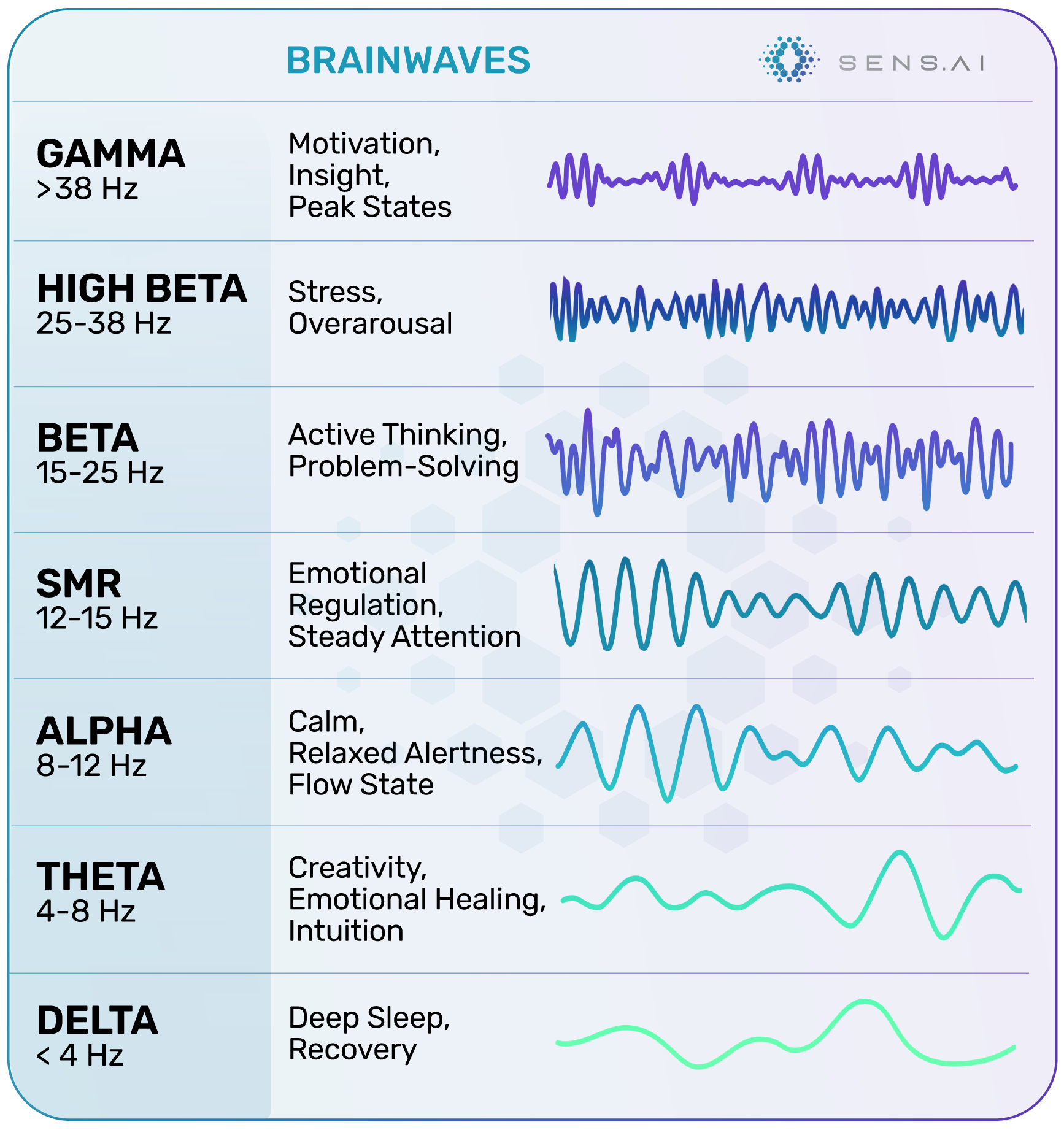
Near the top of the brain's electrical landscape, above the hum of ordinary thinking, there is a frequency band that operates at roughly 40 hertz. Neuroscientists call it gamma. You know it as the moment something clicks. The flash before you articulate the solution. The state where what you were trying to see suddenly becomes clear.
Gamma is the brain's integration frequency. It is where the aha arrives.
And it runs on a foundation that recent research suggests is quietly eroding.
Why gamma matters
Leadership development gives you the downstream qualities: clarity, cognitive flexibility, pattern recognition, the ability to hold a complex situation in view all at once. It almost never tells you where those qualities come from in the brain.
They come from gamma.
Every genuine insight is a gamma event. Every moment of seeing across a problem, of finding the one thread that pulls the whole thing together, of arriving at the decision that others could not quite reach: that is gamma doing its work. The qualities every high-performing person wants are not skills to practice. They are brain states to cultivate.
Training the quality is not enough. You have to train the foundation it runs on.
Gamma is not a fixed trait. It is trainable.
What the research shows
In 2009, cognitive neuroscientists John Kounios and Mark Beeman published findings in Current Directions in Psychological Science that identified the neural signature of insight. The moment of aha was accompanied by a burst of gamma activity in the right temporal lobe, approximately 0.3 seconds before the solution reached conscious awareness. Gamma does not follow insight. It is insight.
Wolf Singer's foundational research on neural synchrony explains the mechanism. Gamma is not simply a signal. It is a binding process. When different regions of the brain need to communicate and integrate information, they synchronize in the gamma band. Perception, attention, working memory, coordinated reasoning: all depend on this synchronized firing. When gamma coherence is strong, the brain thinks in wholes. When it is fragmented, you get pieces but not the picture.
The most striking finding came from a 2004 PNAS study by Lutz, Greischar, Ricard, and Davidson. Long-term meditating practitioners, including individuals with decades of consistent practice, generated sustained high-amplitude gamma synchrony during mental exercises. Deliberately. Without any external stimulus.
This is a significant finding: gamma is not a fixed trait. It is trainable.
The foundation gamma sits on
Gamma does not operate in isolation. It depends on the bands underneath it.
Alpha governs internally directed attention: the quiet, receptive state that allows the brain to hear itself think. Beta governs active analytical processing, the sustained, effortful work of reasoning through a problem step by step.
Gamma cannot run productively on a degraded foundation of alpha and beta brainwaves. A brain with fragmented alpha cannot generate the quiet that insight requires. A brain with weakened beta cannot do the analytical groundwork that creates something worth integrating. Stuck in high beta, you are wired and reactive. Stuck in low alpha, foggy and flat. Swinging between the two, gamma never gets its moment.
This matters because of what recent research is showing about how most people use AI.
Gamma cannot run productively on a degraded foundation of alpha and beta brainwaves.
The cognitive debt finding
A 2025 study from the MIT Media Lab examined 54 participants divided into three groups: those using a large language model, those using a search engine, and those working without digital assistance. EEG was recorded throughout. Frequent LLM users showed the weakest alpha and beta neural connectivity of any group tested. The researchers called this pattern cognitive debt.
One caveat worth naming: this was not a large-scale population trial. Fifty-four participants, with eighteen in the crossover group. The finding is credible and specific. It is not a definitive mass-population result. But the direction it points is consistent with several independent studies, published between 2023 and 2026, that document similar patterns of reduced critical thinking in high-frequency AI users.
The part that matters most: what cognitive debt targets is exactly the foundation gamma sits on.
The physiology underneath
A parallel line of research from Microsoft Research and Carnegie Mellon, published at CHI 2025 and drawing on 319 knowledge workers across 936 work-task examples, found that the strongest protective factor against AI-induced critical thinking decline was not AI literacy. It was self-confidence in one's own cognition.
According to Dr. Drew Pierson, Sens.ai Science Advisory Board, this confidence is not purely psychological. It reflects physiological readiness. It is downstream of HRV, heart rate variability, the autonomic regulation that determines whether the nervous system approaches a task in a state of active engagement or protective offloading. A person with strong HRV coherence shows up ready to think critically. A person with degraded coherence defaults, when a capable tool is available, to delegation.
The brain takes the path of least resistance. If we build systems that make cognitive offloading frictionless, it will offload.
What conscious engagement actually looks like
The research does not argue against using AI. It argues against passive use.
Passive use is the tool generating and the human accepting. Conscious engagement is different. The human sets the direction first. The human critiques the output. The human builds the original idea before the tool enters the process.
Three habits make the practical difference.
Think before you prompt. Before opening the tool, name the problem you are actually trying to solve. One sentence. This is not a productivity ritual. It is a checkpoint that brings the prefrontal cortex online before offloading starts.
Critique the output. Read what the tool produces not as a deliverable but as a first draft from a capable colleague who may have missed something. Your job is to find what it missed. This keeps the evaluative and analytical systems active.
Build the original idea first. Generate something, even a rough paragraph, before the tool does. Then use AI to improve it. Not to replace it. The original act of generation is what the brain needs to stay sharp.
These are not restrictions on how well you use AI. They are the difference between using a tool and being slowly conducted by one.
The conductor
There is a clarifying frame for this.
You are either the conductor of AI, or AI is the conductor of you.
Conducting does not mean playing every instrument. It means holding the whole composition in view: knowing where you are in the piece, making the decisions about emphasis and timing and integration that no single instrument can make. Conducting is precisely what gamma makes possible.
The goal is not to manufacture gamma artificially. It is to build the coherence that makes gamma possible. Gamma-coherent humans, not gamma-jacked ones.
The brain states that support that: alpha for the quiet mind, beta for the analytical work, gamma for the integration. All of them respond to training. The 2004 PNAS data on long-term meditation practitioners shows what sustained practice does to gamma. HRV coherence responds to training. Alpha coherence responds to training.
The infrastructure to protect and build those states now exists. The question is whether you build it before the foundation weakens further, or after.
You are either the conductor of AI, or AI is the conductor of you.
DISCLAIMER
This content is for informational and educational purposes only. It is not intended to provide medical advice or to take the place of such advice or treatment from a personal physician. All readers/viewers of this content are advised to consult their doctors or qualified health professionals regarding specific health questions. Neither the author or Sens.ai, the publisher of this content takes responsibility for possible health consequences of any person or persons reading or following the information in this educational content. All viewers of this content, especially those taking prescription or over-the-counter medications, should consult their physicians before beginning any nutrition, supplement or lifestyle program.