COGNITIVE HEALTHSPAN
What If HRT Isn't Enough? The Brain Side of Menopause

Paola Telfer

If you are somewhere in your 30s, 40s, or 50s and you have started to feel different (not sick exactly, but off), you probably already know some of these by name. Anxiety that arrives without obvious cause. Brain fog that makes you reach for a word and find nothing. Sleep that does not restore you. Hot flashes that interrupt meetings and morning routines. A sense of dysregulation that feels both new and strangely familiar.
Perimenopause. It can begin as early as the mid-30s, and it changes the brain before it changes much else.
The standard conversation about this transition is hormonal. And that conversation is correct. Estrogen, progesterone, and testosterone all shift. Hormone replacement therapy (HRT) replaces what the body is no longer producing at the levels it once was. It is real medicine and it helps.
But it doesn't complete the picture.
The brain changes are not only chemical. They are also electrical.
The layer the hormonal conversation misses
Here is what the hormonal conversation does not fully address: the brain changes are not only chemical. They are also electrical.
The brain is a regulatory system. Under stable hormones, it holds a baseline: the threat-detection system stays calibrated, memory runs, temperature regulation is steady, the autonomic nervous system stays flexible. When estrogen and progesterone shift, they do not only change how you feel chemically. They change the electrical architecture the brain uses to regulate itself.
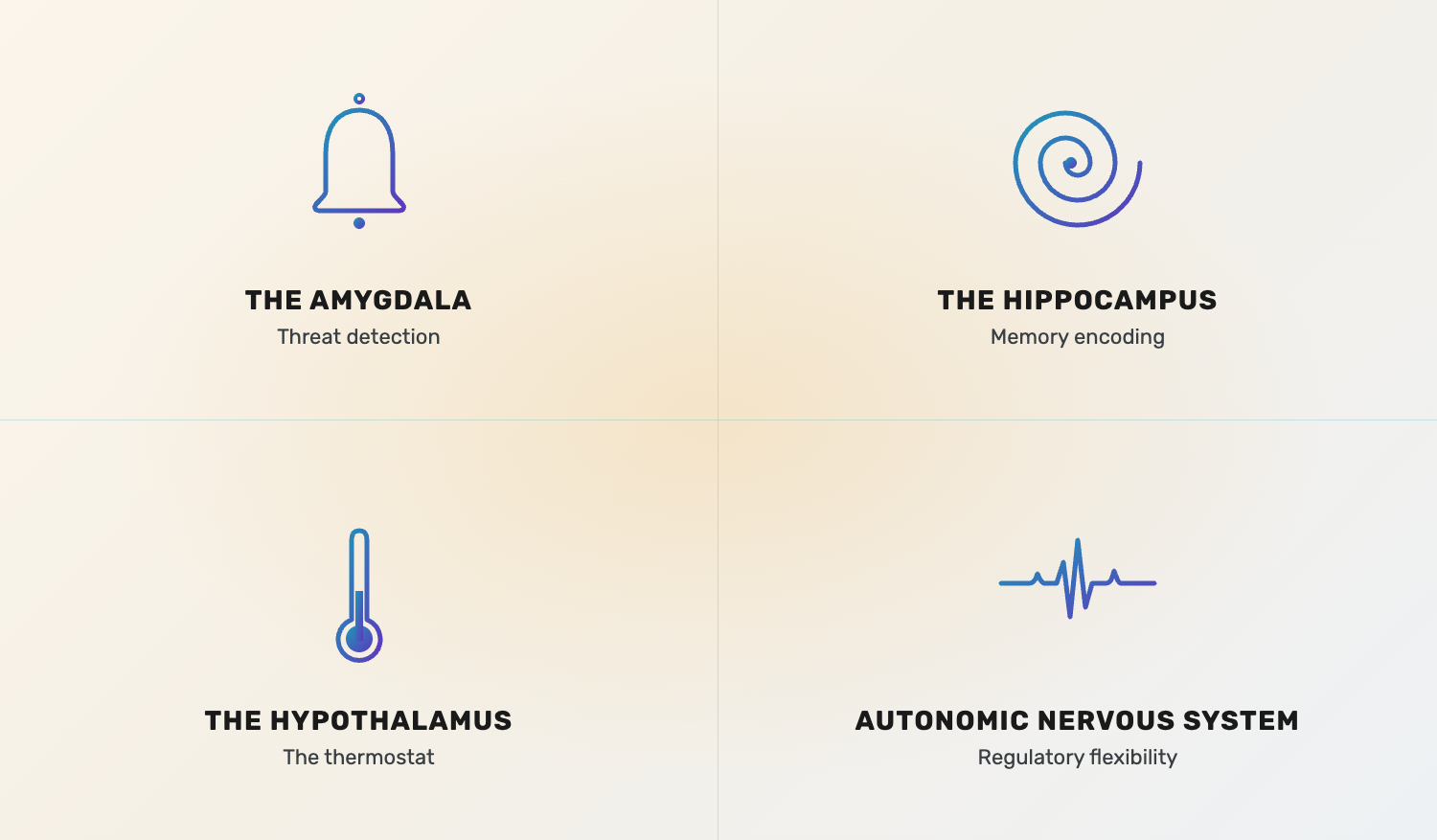
Four systems are affected.
The amygdala. The brain's threat-detection center. Estrogen dampens it. It acts as a brake on the alarm system. When estrogen falls, the brake weakens. The amygdala becomes more excitable: more sensitive to threat, faster to fire, harder to quiet. This is why perimenopausal anxiety often feels different from ordinary worry. The detection system has been recalibrated toward more sensitivity.
The hippocampus. Where memory encoding happens. Estrogen receptors are dense here, and they support synaptic plasticity, the brain's ability to make and consolidate new connections. Dr. Lisa Mosconi, director of the Women's Brain Initiative at Weill Cornell, has documented a measurable decline in hippocampal brain metabolism during the perimenopausal transition. It often shows up years before other changes are visible. The brain fog and word-retrieval difficulties many women experience are not imagined. They have a metabolic and structural signature.
The hypothalamus. The brain's thermostat. It governs body temperature in close coordination with estrogen. When estrogen drops, the hypothalamus' thermal tolerance window narrows. Small changes in body temperature trigger large regulatory responses. Hot flashes are not a malfunction of the thermostat. They are the thermostat doing its job under degraded hormonal inputs.
The autonomic nervous system. Underneath all three, the nervous system itself loses flexibility. Vagal tone decreases. HRV (heart rate variability, the measurable proxy for autonomic adaptability) typically falls. The system that governs how quickly you recover from stress, how well you move between states, how available you are for rest, is running with less range than before.
HRT addresses the chemical inputs these systems depend on. It does not directly retrain the electrical regulation.
The Wisdom Underneath
This is the part most menopause conversations leave out. The transition is not only an ending. It is the doorway into a new phase, the one our culture is finally starting to name out loud: clearer thinking, less performance, more wisdom, less time spent worrying what other people think. The wisdom underneath was always there. The hormonal buffer that quieted it for decades is the same buffer that is now coming down.
The hormonal shift does not only affect the brain's regulatory systems. It removes a buffer that had been quietly holding things in place. For many women, what surfaces when that buffer comes down is not new material. It is old material that the body has been carrying for years, finally close enough to the surface to be felt.
Dr. Tiffany Keenan, a physician focused on women's health, sees this pattern weekly in her practice. During perimenopause, the nervous system has less capacity to absorb stress. At the same time, life is often delivering more of it: children leaving home, careers pivoting, parents aging, the contours of identity shifting. The buffer comes down at the exact moment the load goes up.
What surfaces is real, but it is not new. This is stored material: the stress and unprocessed emotional experience the nervous system has been holding for years, now moving closer to the surface. It can feel like new anxiety. It can look like ADHD. It can read as emotional dysregulation arriving out of nowhere. It is not always what it looks like. It is older material, finally close enough to be felt, because the system that was holding it has less room than it used to.
Dr. Sarah McKay, an Oxford-trained neuroscientist and author of The Women's Brain Book, points to the same pattern: the perimenopausal transition creates the conditions for previously managed emotional content to become unmanageable.
Hormones cannot touch this layer. You can restore estrogen levels and still find that the anxiety, the dysregulation, and the emotional overwhelm persist. That is because these experiences are stored in the nervous system, not in the hormonal system.
The buffer comes down at the exact moment the load goes up.
Meeting the material, not masking it

This is where the electrical conversation becomes practical.
Alpha training increases the brain's coherent alpha activity in the 8-12 hertz range. It has been studied for anxiety and amygdala reactivity. A calmer alpha state corresponds to a quieter threat-detection system. For women experiencing perimenopausal anxiety, this addresses the electrical recalibration directly.
HRV biofeedback trains autonomic flexibility. It is the most direct intervention for restoring the nervous system range the transition reduces. It does not require any hormonal change to work.
For the material that surfaces when the buffer comes down, the approach is sequenced. Stabilize the alpha and beta bands first. That builds the regulatory foundation. Then work with alpha-theta protocols, which allow the nervous system to process stored material in a way that is integrated rather than chaotic. The work meets what surfaces rather than suppressing it again.
I will say this from my own experience. I came to brain training after a car accident that scrambled my nervous system. The regulatory collapse in recovery is not identical to perimenopause, but the architecture is recognizable. When the system that was managing everything stops managing, what is underneath comes to the surface. What brain training gave me was a way to meet that material rather than be overwhelmed by it.
The metabolic cost
One more piece that rarely gets named: hypervigilance is expensive.
A nervous system running in a heightened threat state burns through metabolic resources. Oxidative stress rises. The exhaustion many perimenopausal women describe, the kind that sleep does not fix, is often this. The body is running in a state of low-grade emergency, burning fuel to maintain an alertness that was never consciously asked for.
Brain training reduces that drain by lowering baseline arousal. The exhaustion that does not respond to rest sometimes responds to regulation.
One more piece that rarely gets named: hypervigilance is expensive.
Both/and, not either/or
HRT replaces the chemical inputs that the brain's regulatory systems depend on. That is a real intervention. Where appropriate, it can be very helpful.
Brain training restores the electrical regulation system those inputs support. It also opens access to the layer hormones cannot touch.
This is not a replacement conversation. It is a completion conversation. The body changes visibly during this transition, and we respond to what we can see. The brain changes less visibly. For many women, the response has been incomplete.
The brain has been running your life for three, four, or five decades. It has absorbed experience, managed stress, done the regulatory work that everything else depends on. It deserves at least as much attention as the hormonal chemistry it runs on.
This is not a replacement conversation. It is a completion conversation.
DISCLAIMER
This content is for informational and educational purposes only. It is not intended to provide medical advice or to take the place of such advice or treatment from a personal physician. All readers/viewers of this content are advised to consult their doctors or qualified health professionals regarding specific health questions. Neither the author or Sens.ai, the publisher of this content takes responsibility for possible health consequences of any person or persons reading or following the information in this educational content. All viewers of this content, especially those taking prescription or over-the-counter medications, should consult their physicians before beginning any nutrition, supplement or lifestyle program.